Table of Contents
Dental fillings can last for many years, but there is no exact expiration date for a filling. Some restorations remain in good condition for a decade or longer, while others need repair or replacement sooner because of wear, new decay, cracking, grinding, or changes in the surrounding tooth.
The lifespan of a filling depends on several factors, including the material used, the size and location of the restoration, how much pressure the tooth handles, your oral hygiene, and habits such as clenching or grinding.
That means an older filling does not automatically need replacement just because it has reached a certain age. What matters most is whether the filling and the tooth around it are still healthy and functioning properly.
If you already know a restoration needs treatment, you can learn more about options on our dental fillings page.
How Long Do Dental Fillings Usually Last?
There is no single answer to how long dental fillings last because different restorations experience very different conditions.
The American Dental Association reports that longevity varies among restorative materials and that patient-related factors can play an important role in how long restorations survive. Studies reviewed by the ADA show that many composite and amalgam restorations remain successful for years, but failure rates differ according to the tooth, restoration, material, and individual patient.
Instead of thinking of a filling as something that must be replaced every five, seven, or ten years, it is more useful to think of it as something that should be monitored regularly.
A filling may continue doing its job as long as:
- It remains firmly attached to the tooth
- The material has not fractured
- The surrounding tooth is healthy
- There is no new decay around the restoration
- Your bite remains comfortable
- The tooth does not develop persistent pain or sensitivity
Some fillings fail sooner than expected. Others continue functioning well long after an average lifespan would suggest.
What Factors Affect How Long a Filling Lasts?
A filling’s durability depends on much more than its age.
The size of the filling
A small filling surrounded by plenty of healthy tooth structure generally experiences different stresses than a very large restoration replacing a significant portion of the tooth.
The larger the restoration becomes, the more important the remaining tooth structure and chewing forces may be.
Where the filling is located
Back teeth handle substantial chewing pressure. Restorations on molars may therefore face greater mechanical stress than fillings in lower-load areas.
Your bite
The way your teeth come together determines where chewing forces are concentrated. Certain teeth or restorations may consistently receive more pressure.
Oral hygiene
New decay can develop around the edges of an existing filling. Regular brushing, flossing, and dental care help protect the remaining natural tooth.
Diet and decay risk
Frequent exposure to sugary foods and drinks may increase the conditions that contribute to tooth decay.
Grinding and clenching
Repeated heavy forces can place additional stress on both teeth and restorations.
Because these factors vary from person to person, two people with the same type of filling may have very different experiences.
Do Different Filling Materials Have Different Lifespans?
Yes. Dental materials have different physical properties, advantages, and limitations.
The ADA identifies several direct restorative materials, including composite resin, amalgam, glass ionomer, and resin-modified glass ionomer. Dentists select materials based partly on where a restoration will be placed and how much stress it needs to withstand.
Composite resin
Composite fillings are tooth-colored and are commonly used on both front and back teeth. The ADA describes composite as providing good durability and fracture resistance for appropriately sized restorations.
Long-term studies show that many composite restorations can remain successful for a decade or longer, but longevity varies considerably. The ADA’s review includes research reporting substantial survival of posterior composite restorations at 10 years and beyond.
Amalgam
Amalgam has historically been valued for durability and resistance to wear, particularly in areas exposed to significant chewing forces. The ADA continues to describe amalgam as a durable restorative material.
Existing amalgam fillings that are in good condition do not need to be replaced simply because they are old.
Glass ionomer
Glass ionomer materials may be appropriate in certain situations, but they are generally not intended for the same heavy load-bearing applications as stronger restorative materials. ADA evidence has shown lower long-term survival rates for glass ionomer restorations in some applications.
Gold and porcelain restorations
Some restorations known as inlays or onlays may be made from materials such as gold or porcelain. Cleveland Clinic notes that these indirect restorations may last approximately 10 to 20 years, though individual results vary.
Material matters, but it is only one part of the equation. Placement, restoration size, oral health, and daily habits are also important.
Can Grinding or Clenching Wear Down Fillings Faster?
Grinding and clenching can place significant pressure on teeth and existing dental work.
These forces may occur while you are awake or during sleep, sometimes without you realizing it. Over time, repeated stress can contribute to wear, cracking, or fracture of both natural teeth and restorative materials.
ADA research notes that strong chewing and clenching forces can contribute to microscopic cracking in composite restorations. These small defects may eventually contribute to larger fractures or restoration failure.
Possible signs that grinding is affecting your teeth include:
- Flattened or worn tooth surfaces
- Chipped teeth
- Frequent restoration problems
- Jaw soreness
- Morning jaw fatigue
- Tooth sensitivity
If you repeatedly break fillings or dental work, tell your dentist. The pattern may provide important information about the forces affecting your teeth.
What Are the Signs a Filling Needs to Be Replaced?
A damaged filling is not always obvious.
Sometimes your dentist notices a change during a routine examination before you feel anything. In other cases, the tooth begins producing noticeable symptoms.
Signs worth having checked include:
- New sensitivity to hot or cold
- Pain when chewing or biting
- A rough or sharp area on the tooth
- Food repeatedly catching around the filling
- A visible crack
- A piece of filling breaking away
- A filling that feels loose
- A noticeable gap between the tooth and restoration
- New discoloration around the edge of a filling
- A persistent toothache
None of these symptoms automatically proves that the entire filling must be replaced. Your dentist needs to evaluate the tooth to determine the cause and appropriate treatment.
Can a Filling Crack or Come Loose?
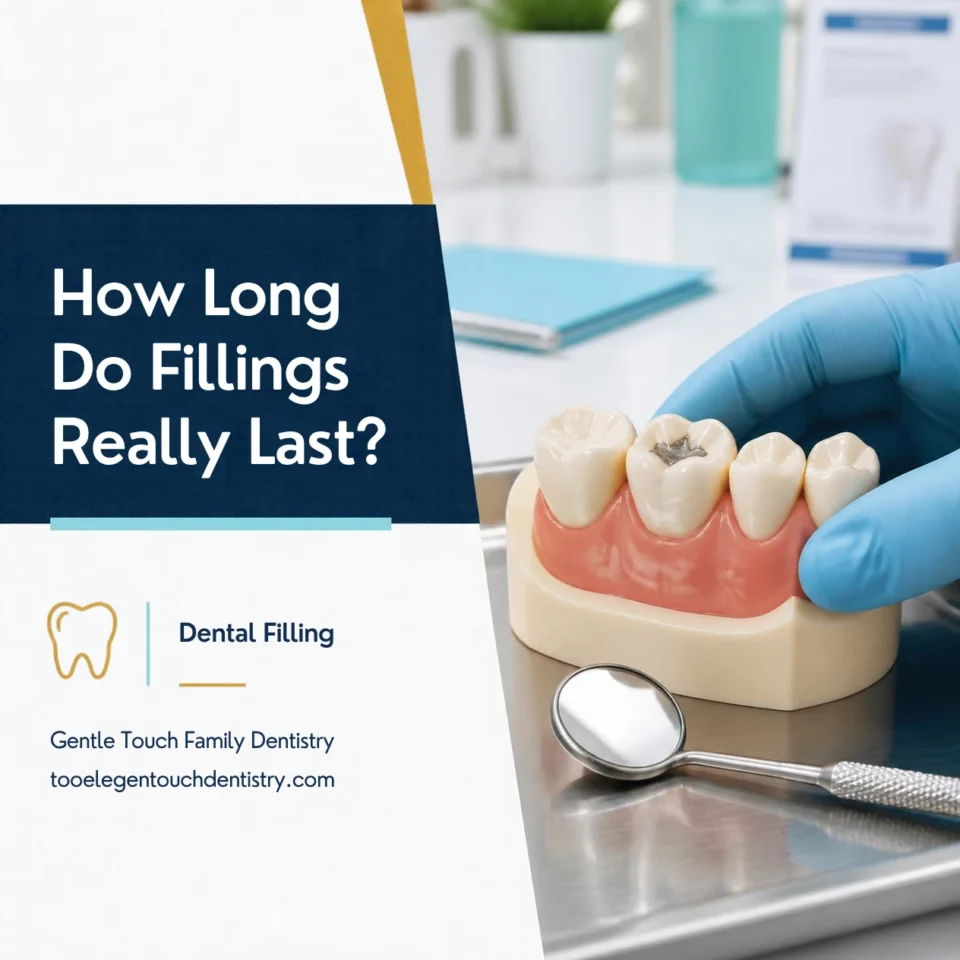
Yes. Fillings experience years of biting, chewing, temperature changes, and normal wear.
A restoration may eventually chip, fracture, loosen, or separate from part of the tooth. Composite materials in particular can develop cracks under repeated mechanical stress, and fracture is one documented reason restorations may fail.
If part of a filling comes out, avoid chewing hard foods on that side until the tooth can be evaluated.
Do not try to permanently repair the filling yourself. A dentist needs to determine how much of the restoration remains and whether the underlying tooth has also been damaged.
What Happens If an Old Filling Is Not Replaced?
An old filling does not necessarily need to be replaced.
If it is intact, functional, and surrounded by healthy tooth structure, its age alone is not a reason for removal. The ADA specifically states that sound amalgam fillings should not be removed or replaced unless replacement is considered medically necessary.
A failing restoration is different.
If a damaged filling allows bacteria and plaque to accumulate around an opening or weakened area, decay can develop in the surrounding tooth structure. Fractures may also grow larger under continued chewing forces.
Depending on the situation, delaying treatment could eventually mean that more tooth structure needs to be repaired.
The key is not to replace every old filling. It is to identify fillings that are no longer protecting the tooth adequately.
Can Good Oral Hygiene Help Fillings Last Longer?
Yes. Fillings repair damaged areas, but the rest of the tooth still needs protection.
You can help maintain both your restorations and natural teeth by:
- Brushing twice daily with fluoride toothpaste
- Cleaning between your teeth regularly
- Limiting frequent sugary snacks and drinks
- Keeping routine dental appointments
- Avoiding chewing ice or other extremely hard objects
- Discussing grinding or clenching with your dentist
- Having new sensitivity or pain evaluated rather than ignoring it
A filling itself cannot develop a cavity, but the natural tooth around its edges still can.
Maintaining the surrounding tooth is therefore an important part of maintaining the restoration.
For broader information about routine dental care and tooth maintenance, visit our general dentistry page.
How Do Dentists Check Existing Fillings?
During a dental examination, your dentist can evaluate existing restorations along with the surrounding tooth structure.
The evaluation may include checking for:
- Cracks or fractures
- Worn areas
- Loose or damaged portions
- Changes around the edges of the restoration
- New decay
- Bite-related problems
- Tooth sensitivity
- Damage to the surrounding tooth
Dental X-rays may also be appropriate in some situations to help identify problems that cannot be seen directly during a visual examination.
The goal is not necessarily to replace older fillings. It is to determine whether each restoration is still doing what it was designed to do.
When Should You Schedule a Dental Evaluation?
You do not need to wait until a filling falls out completely before having it checked.
Schedule an evaluation if:
- A filling feels loose or broken
- Part of the restoration falls out
- The tooth hurts when you bite
- You develop new or worsening sensitivity
- You notice a visible crack
- Food consistently becomes trapped around the restoration
- The tooth begins aching without an obvious reason
Cleveland Clinic also advises contacting a dentist when a filled tooth develops significant pain, including pain when biting or intense, lingering sensitivity to hot or cold.
Even without symptoms, regular dental visits allow existing fillings to be monitored over time.
If you are looking for dental care in Tooele, Gentle Touch Family Dentistry can evaluate existing restorations and help determine whether they are still functioning properly. Learn more about our local practice on our Tooele dentist page.
FAQs
How often do dental fillings need to be replaced?
There is no standard replacement schedule for dental fillings. Some remain functional for many years, while others require treatment sooner because of cracking, decay, wear, or other problems.
A dentist can monitor your restorations during routine examinations and recommend replacement when there is a clinical reason to do so.
Can a dental filling last 20 years?
Some restorations can remain functional for 20 years or longer, but that should not be considered a guaranteed lifespan. Cleveland Clinic notes that certain dental restorations, including indirect fillings, may last 10 to 20 years, while ADA research demonstrates wide variation in survival among filling types and patients.
The condition of the individual restoration matters more than its age alone.
How do I know if an old filling is bad?
Possible warning signs include pain when biting, new sensitivity, a rough or sharp edge, visible cracking, food catching around the filling, or a restoration that feels loose.
Some failing fillings do not cause noticeable symptoms, which is one reason routine dental evaluations remain important.
Do white fillings wear out faster than silver fillings?
Not necessarily in every situation. Historically, amalgam has been known for durability, but modern composite materials can also perform well for many years. ADA reviews show that longevity depends on several factors beyond material alone, including the restoration, tooth, and patient.
Your dentist can recommend a material based on the location and needs of the particular tooth.
Does a cracked filling always need to be replaced?
Not every restoration problem requires exactly the same treatment. The appropriate approach depends on where the damage is, how much filling remains, and whether the surrounding tooth is healthy.
A dentist needs to examine the restoration before determining whether it can be repaired or should be replaced.
Should an old filling be replaced if it does not hurt?
Not automatically. A filling that remains intact and functional may not require treatment solely because of its age.
However, some problems develop without pain, so existing restorations should still be checked during regular dental visits.
Dental fillings are designed to restore and protect damaged teeth, but they are not expected to last forever. The important question is not simply how old your filling is it is whether the filling and the surrounding tooth are still healthy.
If a filling feels loose, causes new sensitivity, hurts when you chew, or simply has not been checked in some time, Gentle Touch Family Dentistry can evaluate the restoration and explain whether it still looks stable or needs attention.
Learn more about dental fillings, explore our general dentistry services, or visit our Tooele dentist page to learn more about care available for patients in the area.