Table of Contents

A small cavity may not hurt at first, but that does not mean it will stay small. Once tooth decay has created an actual hole in the enamel, the missing tooth structure cannot repair itself on its own. Without appropriate care, decay can continue deeper into the tooth and may eventually cause sensitivity, pain, infection, or the need for more involved treatment.
There is an important distinction between a true cavity and the earliest stage of tooth decay. Early mineral loss that has not yet created a hole may sometimes be stopped or reversed with measures such as fluoride and improved preventive care. Once the enamel has broken down and a cavity has formed, a dentist generally needs to repair the damaged area.
The earlier decay is identified, the more opportunity there may be to manage the problem before a larger portion of the tooth becomes involved.
If you already know that a cavity needs to be restored, you can learn more about treatment on our dental fillings page.
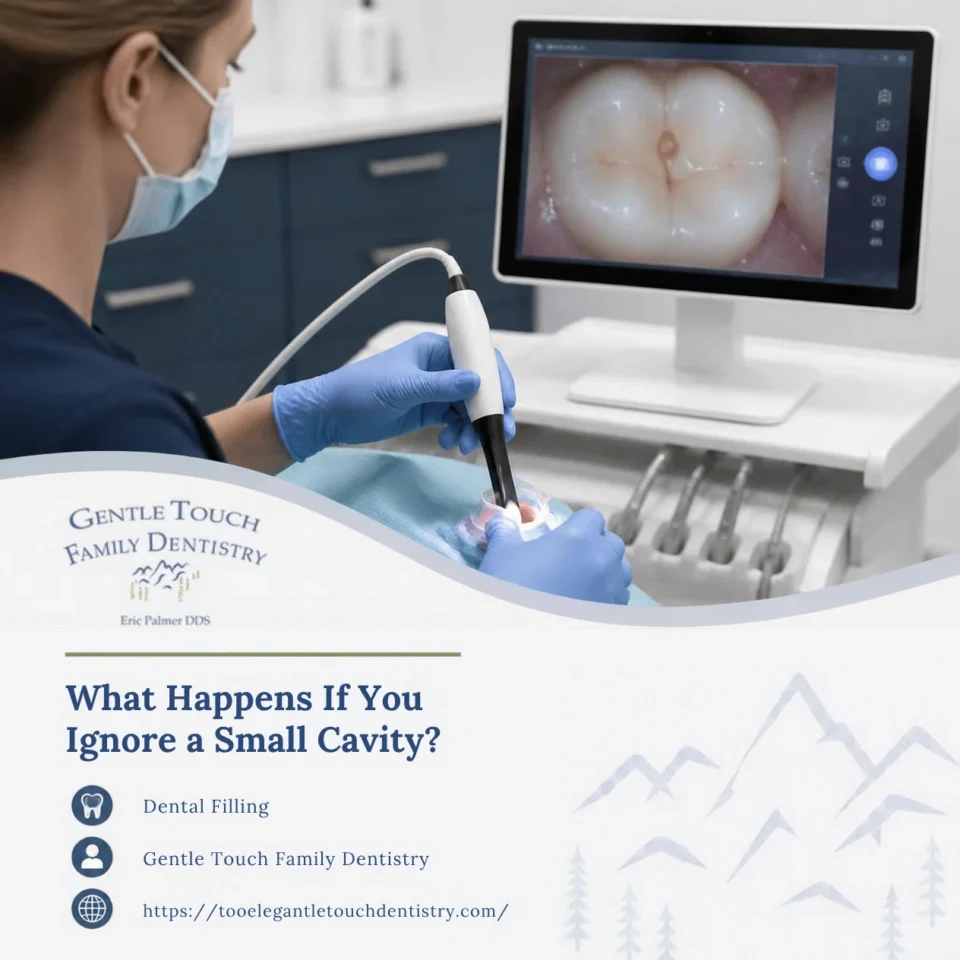
What Happens If You Ignore a Small Cavity?
If a true cavity is left untreated, the decay process can continue.
Cavities develop when acids produced by bacteria contribute to mineral loss from the tooth. As that process continues, enamel can weaken and eventually break down. Once decay progresses past the enamel, it can reach deeper layers of the tooth.
At first, you may notice little or nothing.
Over time, however, an untreated cavity may lead to:
- A larger area of damaged tooth structure
- Sensitivity to sweets, hot foods, or cold drinks
- Toothache
- Pain while chewing
- Infection within the tooth
- An abscess
- The need for more extensive dental treatment
How quickly decay progresses varies from person to person and from tooth to tooth. That is why the absence of pain is not a reliable way to judge whether a cavity is getting worse.
Can a Small Cavity Get Bigger Over Time?
Yes. A small cavity can become larger if the decay process remains active.
Tooth decay is not simply a one-time event. It is a continuing disease process influenced by factors such as plaque bacteria, diet, fluoride exposure, saliva, oral hygiene, and an individual’s cavity risk.
As more minerals are lost, the damaged area can extend farther through the tooth.
A cavity that initially affects a relatively small portion of enamel may eventually involve dentin, the softer layer beneath the enamel. If decay progresses still farther, it can approach the pulp, where the tooth’s nerves and blood vessels are located.
This is one reason dentists usually recommend monitoring or treating decay based on its stage rather than waiting for symptoms.
How Does Tooth Decay Progress?
Tooth decay generally develops in stages.
Early mineral loss
The earliest stage may appear as a white spot on the enamel. At this point, the surface may still be intact.
Early non-cavitated decay may sometimes be stopped or reversed through fluoride, saliva, improved oral hygiene, dietary changes, and other preventive measures.
Enamel breakdown
If mineral loss continues, the enamel can eventually weaken enough to form a hole.
Once a true cavity has formed, the structural damage is permanent and usually needs to be restored by a dentist.
Dentin involvement
Beneath the enamel is dentin. This layer is less mineralized than enamel, and decay can continue through it toward the center of the tooth.
Sensitivity may become more noticeable once deeper tooth structure is involved.
Pulp involvement
The pulp is the soft tissue at the center of the tooth containing nerves and blood vessels.
If decay reaches this area, the tooth may become inflamed or infected. At that stage, treatment can be significantly different from repairing a small cavity.
Can a Small Cavity Start Causing Pain?
Yes, but cavities often do not hurt in their early stages.
The National Institute of Dental and Craniofacial Research notes that early tooth decay usually does not cause symptoms. As decay advances, it may produce toothache or sensitivity to sweets, heat, or cold.
Possible symptoms include:
- Sensitivity to cold drinks
- Sensitivity to hot foods
- Discomfort when eating sweets
- Pain while biting
- A dull toothache
- Sharp pain in a particular tooth
The important point is that pain is not required for a cavity to be present.
Waiting until a tooth hurts can allow decay to advance considerably before it receives attention.
What Happens If Decay Reaches the Dentin?
Dentin sits beneath the enamel and makes up a large portion of the tooth.
Once decay reaches dentin, the cavity has moved beyond the tooth’s hard outer shell. Because dentin is structured differently from enamel, the lesion may continue spreading toward the pulp if the disease remains active.
This stage may also increase the likelihood of sensitivity.
A dentist will consider several factors when determining treatment, including:
- How far the decay has progressed
- How much healthy tooth structure remains
- Where the cavity is located
- Whether the tooth is causing symptoms
- The patient’s overall cavity risk
Treatment recommendations are therefore based on the individual tooth rather than cavity size alone.
Can an Untreated Cavity Lead to Infection?
Yes. If decay travels far enough into a tooth, bacteria can reach the pulp.
The pulp contains nerves and blood vessels. When bacteria enter this tissue, inflammation and infection can develop. An untreated infection may eventually create an abscess, which is a collection of pus associated with infection.
Signs that may occur with an abscess include:
- Significant tooth pain
- Gum or facial swelling
- Redness
- A bad taste in the mouth
- Fever
An abscess requires professional dental attention.
This does not mean every small cavity is about to become infected. It means that infection is one possible outcome when decay continues deep enough without treatment.
When Does a Cavity Need More Than a Filling?
A relatively small cavity can often be restored with a dental filling after the decayed tooth structure is removed.
If significantly more tooth structure becomes damaged, a filling may no longer be the most appropriate restoration.
Depending on the condition of the tooth, treatment for more advanced decay could involve:
- A larger restoration
- A crown to protect a badly weakened tooth
- Root canal treatment if the pulp becomes severely inflamed or infected
- Extraction in situations where the tooth cannot predictably be restored
A deep cavity or serious tooth infection is one reason a dentist may recommend root canal treatment to help save the tooth.
Treatment is determined by an examination and, when appropriate, dental X-rays.
Can Early Treatment Help Save More Tooth Structure?
Often, yes.
One goal of treating decay early is to address the damaged area before it becomes more extensive.
If a cavity remains relatively limited, the dentist may be able to remove a smaller amount of damaged tissue and restore the tooth. If decay progresses deeper or causes additional structural damage, treatment may need to involve more of the tooth.
Modern cavity management also recognizes that not every early lesion requires the same treatment. The ADA describes dental caries as a continuum and recommends management based on the stage of disease and the patient’s risk factors.
That makes early detection useful even when a filling is not immediately required. Your dentist can determine whether an area should be monitored, managed preventively, or restored.
How Can Preventive Dentistry Help Catch Cavities Earlier?
Preventive dental visits give your dental team an opportunity to identify changes before they become painful.
During routine care, your dentist may look for:
- Early enamel changes
- Visible cavities
- Areas where plaque tends to accumulate
- Existing fillings that need monitoring
- Signs of increased cavity risk
Dental X-rays may also reveal decay in areas that are difficult to see directly, such as between teeth.
Preventive care may also include recommendations involving fluoride, brushing and flossing habits, diet, and other strategies based on your individual risk.
For more information about protecting your teeth between appointments, visit our preventive dentistry page.
When Should You See a Dentist for a Suspected Cavity?
It is a good idea to schedule a dental evaluation if you suspect that you have a cavity, even if the tooth does not hurt.
Signs worth having checked include:
- A visible hole or dark area in a tooth
- New sensitivity to sweets
- Sensitivity to hot or cold temperatures
- Pain while chewing
- Food repeatedly getting caught in one area
- A toothache
- A rough or damaged area you can feel with your tongue
You should also keep routine dental visits even when you have no symptoms, because early decay may not cause noticeable discomfort.
If you are looking for dental care in Tooele, Gentle Touch Family Dentistry can evaluate a suspected cavity and explain whether the area needs treatment or monitoring.
Learn more about our practice on our Tooele dentist page.
FAQs
Can a small cavity heal on its own?
It depends on what is meant by “cavity.” Very early tooth decay that has caused mineral loss but has not yet formed a hole may sometimes be stopped or reversed with fluoride and other preventive measures.
Once the enamel has physically broken down and a true cavity has formed, that lost tooth structure does not regenerate on its own.
How long can you leave a small cavity untreated?
There is no reliable timeline that applies to every cavity. Decay can progress at different rates depending on the tooth and factors such as oral hygiene, diet, saliva, fluoride exposure, and overall cavity risk.
A dentist can determine the stage of the lesion and whether it should be monitored, treated preventively, or restored.
Will I know if a cavity is getting worse?
Not necessarily. Early tooth decay often has no symptoms.
As it progresses, you may develop sensitivity or tooth pain, but waiting for discomfort is not the best way to monitor a known cavity.
What happens when a cavity reaches the nerve?
When decay reaches the pulp at the center of the tooth, the tissue can become inflamed or infected. Significant decay or infection may require root canal treatment to save the tooth in some cases.
Can a cavity turn into an abscess?
Yes. Deep decay can allow bacteria to reach the pulp, and an infection may eventually result in an abscess.
Symptoms can include pain, swelling, gum redness, a bad taste, or fever.
Is it better to fill a cavity early?
When a true cavity requires restoration, addressing it before it becomes larger may help limit how much tooth structure becomes involved.
However, very early non-cavitated decay may sometimes be managed without a filling. Your dentist can determine the appropriate approach based on how far the decay has progressed.
A small cavity may seem easy to put off, especially when the tooth does not hurt. But tooth decay can continue quietly, and treatment needs may change as more of the tooth becomes involved.
If you think you have a cavity or a dentist has already identified an area of decay Gentle Touch Family Dentistry can evaluate the tooth and explain what stage the decay has reached and what options are appropriate.
Learn more about dental fillings, explore our preventive dentistry services, or visit our Tooele dentist page to learn more about dental care available in the area.