Table of Contents
A permanent tooth that suddenly feels loose can be unsettling. Unlike baby teeth, adult teeth are meant to remain securely supported by the gums, periodontal ligament, and bone surrounding their roots.
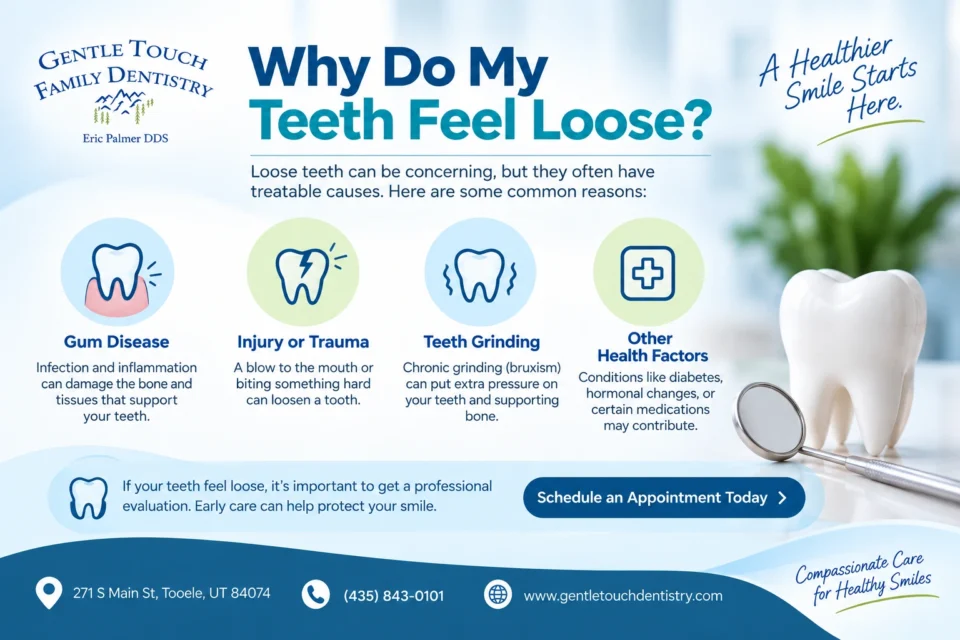
If you are asking why do my teeth feel loose, there are several possible explanations. Gum disease can weaken the tissues and bone supporting a tooth, while an injury may temporarily or permanently affect its stability. Excessive forces from grinding or clenching, inflammation around a tooth, and other dental problems may also contribute.
A loose-feeling tooth does not automatically mean the tooth will be lost. What matters is why it is moving, how much mobility is present, and whether the supporting tissues have been damaged.
Because the cause cannot be determined by feel alone, new or persistent tooth mobility should be examined by a dentist. Sudden looseness after an accident, significant pain, swelling, bleeding, or a tooth that has changed position deserves especially prompt attention.
Why Do My Teeth Feel Loose?
Teeth are not fused directly to the jawbone. Each tooth root is surrounded by a periodontal ligament, a specialized tissue that connects the tooth to the surrounding bone and allows a very small amount of natural movement.
That normal movement is usually so slight that you do not notice it.
When an adult tooth begins to feel noticeably mobile, however, something may be affecting the tooth itself or the structures that support it.
Possible explanations include:
- Periodontal or gum disease
- Loss of supporting bone around a tooth
- Dental trauma or injury
- Excessive biting, clenching, or grinding forces
- Damage to the tooth or root
- Inflammation or infection around a tooth
- Changes affecting the way the teeth come together
Sometimes patients notice mobility while chewing, brushing, flossing, or touching a tooth with their tongue. A tooth may also feel different when biting even if you cannot clearly see it moving.
Avoid repeatedly wiggling the tooth to test it. Continued pressure will not tell you what caused the problem and may further irritate an already injured area.
Instead, pay attention to other symptoms and arrange an evaluation if the looseness is new or persists.
What Causes Loose Teeth in Adults?
Several dental conditions can affect tooth stability. The cause may involve the gums and bone, the tooth itself, or outside forces acting on the tooth.
Periodontal disease
One of the more important causes of adult tooth mobility is advanced periodontal disease.
Periodontal disease affects the tissues that hold teeth in place. As it progresses, inflammation can damage the supporting bone around the roots. NIDCR notes that advanced gum disease can lead to loose or shifting teeth as supporting bone is destroyed.
Dental injuries
A fall, sports injury, automobile accident, or blow to the mouth can loosen a tooth even if the tooth is not completely knocked out.
Sometimes the tooth shifts visibly. Other times, it remains in approximately the same position but feels mobile or painful when touched.
Dental trauma should be evaluated promptly because neighboring teeth and deeper structures may also be injured even when the damage is not obvious from the outside.
Grinding and clenching
Grinding or clenching the teeth, known as bruxism, places repeated force on the teeth and jaws.
Common signs can include tooth wear, chips, cracks, jaw tenderness, and headaches. Grinding does not automatically mean a tooth will become loose, and a loose tooth should not be diagnosed as a grinding problem based on symptoms alone. However, excessive bite forces may be one factor a dentist considers during an evaluation.
Damage to the tooth or root
A crack, fracture, or previous injury can affect how stable or comfortable a tooth feels.
Some root fractures occur after trauma and may not be easy to see without professional examination and dental imaging. Depending on the type and location of the injury, stabilization or other treatment may be necessary.
Inflammation or other dental problems
Pain or a sensation that a tooth feels different when biting can also occur with inflammation around a tooth or its supporting structures.
Because several dental problems can create similar sensations, an examination is necessary before deciding whether the tooth is truly mobile and what is causing the change.
Can Gum Problems Make Teeth Feel Loose?
Yes. Gum problems can affect tooth stability when disease progresses far enough to damage the tissues and bone supporting the teeth.
Gingivitis, the earliest stage of gum disease, involves inflammation of the gums. You might notice redness, swelling, or bleeding. At this stage, the deeper bone supporting the teeth has not necessarily been damaged.
Periodontitis is more advanced.
As periodontal disease progresses, pockets can develop between the teeth and gums, and supporting bone can be lost. NIDCR identifies loose or sensitive teeth, receding gums, pain while chewing, and persistent bad breath among possible signs of periodontal disease.
Possible warning signs to watch for include:
- Gums that frequently bleed
- Red, swollen, or tender gums
- Gum recession
- Persistent bad breath
- Changes in the spaces between teeth
- Pain or discomfort when chewing
- Teeth that appear to be shifting
- Increasing tooth mobility
A loose tooth does not prove that you have periodontal disease. Trauma and other dental conditions can create mobility as well.
If gum disease is contributing, however, addressing the periodontal problem becomes an important part of protecting the remaining support around the tooth.
Treatment depends on how advanced the condition is. Dental professionals may use periodontal measurements and X-rays to evaluate gum pockets and the amount of bone supporting the teeth.
Can Grinding or an Injury Cause Tooth Mobility?
Both excessive forces and dental trauma can affect how a tooth feels, although they do so in different ways.
Grinding and clenching
Bruxism repeatedly exposes the teeth to forces outside normal chewing.
Over time, patients who grind may develop flattened or worn tooth surfaces, chips, cracks, jaw soreness, or headaches. A dentist may also examine the patient’s bite and the tissues supporting a tooth if mobility is present.
If grinding is contributing to dental damage, treatment may include strategies to protect the teeth. A dentist may recommend a night guard in appropriate cases, although the best solution depends on the individual and the cause of the grinding.
Dental trauma
An injury is a more urgent potential cause of sudden looseness.
A permanent tooth can be pushed sideways, partially out of its socket, farther into the socket, or simply loosened by impact without obvious displacement.
The American Association of Endodontists advises that traumatic dental injuries receive prompt examination because the severity of an injury is not always visible, and nearby teeth may also be affected.
Depending on the injury, a dentist may need to reposition and stabilize a tooth. Some traumatic injuries are treated with a temporary flexible splint that allows the supporting tissues to heal. More complicated injuries may need additional treatment and follow-up.
Do not repeatedly push a loose tooth back and forth after an accident. Contact a dental professional for guidance and evaluation instead.
How Does a Dentist Evaluate a Loose Tooth?
The evaluation begins by determining whether the tooth is actually mobile and looking for the reason behind the change.
Your dentist may ask:
- When did you first notice the looseness?
- Did it happen suddenly or gradually?
- Have you recently fallen or been hit in the mouth?
- Does the tooth hurt when you bite?
- Have your gums been bleeding or swelling?
- Do you grind or clench your teeth?
- Have you noticed gum recession or changes in your bite?
The dentist will then examine the tooth, gums, and surrounding structures.
Checking tooth mobility
The dentist can carefully assess how much movement is present and the direction in which the tooth moves.
This provides more useful information than repeatedly testing the tooth yourself.
Examining the gums
If periodontal disease is a concern, the dentist or dental hygienist may use a small periodontal probe to measure the spaces between your teeth and gums.
NIDCR notes that these measurements help identify deeper periodontal pockets that may be associated with gum disease.
Taking dental X-rays
X-rays may be recommended to look at the bone surrounding the tooth, the root, and other structures that cannot be fully evaluated by looking inside the mouth.
Imaging can be particularly useful when the dentist suspects bone loss, trauma, or damage involving the tooth root.
Checking your bite
Your dentist may also have you bite down to see how the tooth contacts the teeth above or below it.
If a tooth is receiving unusual pressure, that information can help with diagnosis and treatment planning.
The important point is that tooth mobility is a symptom, not a diagnosis. Treatment should address the underlying cause.
What Treatment Options Are Available for Loose Teeth?
Treatment varies considerably depending on why the tooth is moving.
A loose permanent tooth does not automatically need to be extracted. In some cases, addressing the underlying problem may help stabilize the area or preserve the tooth.
Periodontal treatment
When gum disease has damaged the supporting tissues, treatment focuses on controlling periodontal infection and inflammation and protecting the remaining bone and gum support.
Treatment may include professional periodontal cleaning such as scaling and root planing, ongoing periodontal maintenance, and, in more advanced cases, additional periodontal procedures.
The appropriate approach depends on the extent of the disease and supporting bone loss. NIDCR notes that scaling and root planing may be used to treat periodontitis, while more advanced disease may require additional treatment.
Stabilizing an injured tooth
If trauma has loosened or displaced a tooth, a dentist may temporarily stabilize it by attaching it to neighboring teeth with a flexible splint.
This is not appropriate for every loose tooth, and the duration depends on the specific injury. Dental trauma guidelines recommend stabilization for certain luxation injuries while the supporting tissues heal.
Addressing grinding or excessive forces
When grinding or clenching contributes to damage, the dentist may recommend measures intended to protect the teeth and reduce harmful forces.
For some patients, that may include a custom night guard. Treatment should still be based on an examination because grinding may exist alongside another problem rather than being the sole cause of mobility.
Treating damaged or infected teeth
A tooth affected by a fracture, injury, infection, or other structural problem may need restorative or endodontic care.
For example, certain traumatic injuries can damage the dental pulp inside a tooth and may eventually require root canal treatment. The treatment decision depends on the type of injury and how the tooth responds over time.
Removing a tooth when it cannot be saved
Sometimes a tooth has lost too much support or sustained damage that cannot be predictably repaired.
Extraction may then be considered, but it is not the automatic treatment for every mobile tooth. A dentist needs to evaluate the tooth’s condition, supporting bone, symptoms, and long-term outlook first.
When Is a Loose Tooth a Dental Emergency?
A tooth that gradually becomes slightly mobile should still be evaluated, but some situations require more urgent attention.
Seek prompt dental care if:
- A permanent tooth suddenly becomes loose
- The looseness follows a fall, sports accident, or blow to the face
- The tooth has moved out of its normal position
- You experience significant tooth or jaw pain
- There is substantial bleeding around the tooth
- The gums or face become noticeably swollen
- You have signs of infection along with the loose tooth
- The tooth is nearly knocked out
- You cannot bite normally after an injury
Dental trauma is especially time-sensitive. The AAE recommends immediate examination for traumatic dental injuries because fast treatment may influence the ability to preserve an injured tooth.
If a permanent tooth is completely knocked out, the ADA advises keeping it moist and getting to a dentist as quickly as possible. Handle it by the crown rather than the root.
Patients in Tooele who have a suddenly loose or injured tooth can learn more about Emergency Dentistry and contact the dental office for guidance on how quickly they should be seen.
Severe facial trauma, uncontrolled bleeding, or swelling that affects breathing or swallowing may require emergency medical attention rather than waiting for a routine dental appointment.
FAQs
Is it normal for adult teeth to move slightly?
Teeth are supported by a periodontal ligament rather than being fused directly to the bone, so a very small amount of physiologic movement can occur. However, new, increasing, or noticeable mobility in a permanent tooth should be evaluated by a dentist.
Can a loose adult tooth tighten again?
It depends on the cause. A mildly injured tooth may sometimes become more stable as supporting tissues heal, while mobility caused by periodontal bone loss requires treatment of the underlying gum disease. A dentist must evaluate the amount of support remaining before predicting the outcome.
Does a loose tooth always mean gum disease?
No. Gum disease is one important cause of adult tooth mobility, but trauma, excessive biting forces, fractures, and other dental problems can also contribute. The pattern of mobility and condition of the surrounding tissues help a dentist determine the likely cause.
Can teeth grinding make my teeth feel loose?
Grinding and clenching can place substantial forces on teeth and may contribute to tooth wear, chips, cracks, and other dental problems. If a tooth feels loose, however, do not assume grinding is the only explanation. A dentist should also check the gums, bone, tooth structure, and bite.
Should I keep checking a loose tooth with my tongue or fingers?
No. Repeatedly pushing or wiggling an already mobile tooth can irritate the area and does not help determine why the tooth is loose. Try to leave the tooth alone and arrange a professional evaluation.
How quickly should I see a dentist for a loose permanent tooth?
New or persistent mobility should be evaluated rather than left until a routine visit months away. If the tooth becomes loose suddenly after an injury, has shifted position, or is accompanied by significant pain, swelling, or bleeding, seek prompt dental care.
Don’t Ignore a Loose Tooth—Let Gentle Touch Family Dentistry Take a Look
A permanent tooth that feels loose can have several possible causes, and noticing mobility does not automatically mean the tooth is beyond saving. The best next step is to determine what is affecting the tooth and the tissues supporting it.
At Gentle Touch Family Dentistry, we help patients in Tooele understand unexpected changes in their teeth and gums and determine appropriate next steps. If a tooth has started to feel loose, especially if you also have gum bleeding, sensitivity, pain, swelling, or a recent dental injury, schedule an evaluation with our team.
Prompt attention can help identify whether the problem involves periodontal support, trauma, excessive forces, or another dental condition and allow your dentist to discuss options for protecting your oral health.