Table of Contents
If you skip dental cleanings for years, it does not automatically mean you will have serious dental problems. However, going a long time without professional cleanings gives plaque and tartar more opportunity to accumulate and may increase your risk of cavities, gum inflammation, gum disease, persistent bad breath, and other oral health concerns.
The effects can vary considerably from one person to another. Your brushing and flossing habits, diet, tobacco use, saliva, existing dental conditions, and other individual factors can all influence what happens during a long gap in professional care.
Even if your teeth feel fine, it can still be worthwhile to return to the dentist. Some problems involving the teeth and gums can develop without obvious symptoms, and an evaluation is the best way to understand your current oral health.
Do Not Wait for Dental Pain
Years without cleanings can put your teeth and gums at risk. Call today and get your oral health back on track.
What Happens When You Skip Dental Cleanings for Years?
Daily brushing and interdental cleaning are important parts of maintaining healthy teeth and gums, but professional dental cleanings serve a different purpose.
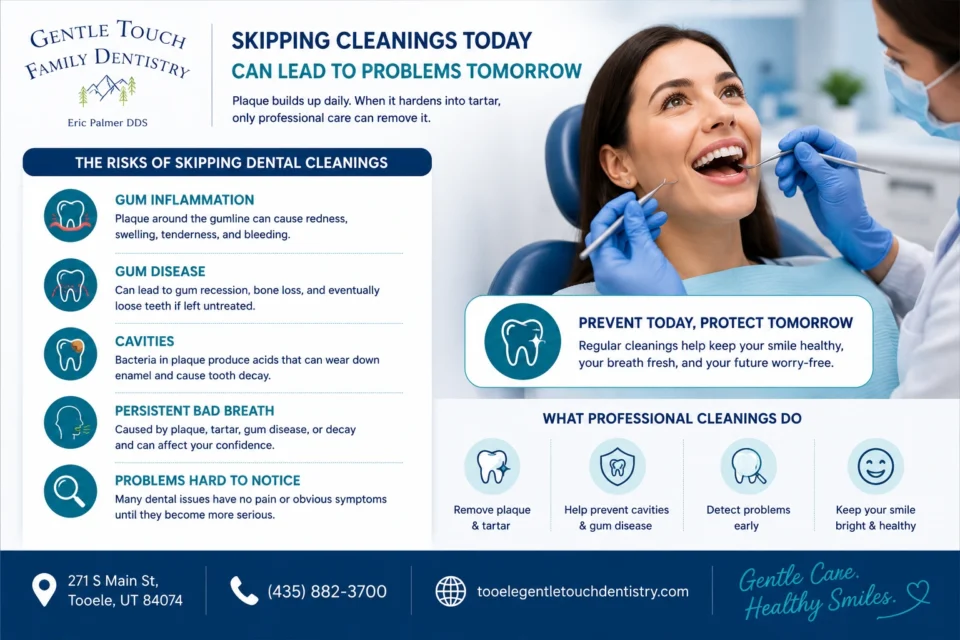
Plaque is a sticky film that continually develops on the teeth. Brushing and flossing help remove plaque, including from areas that can otherwise be easy to miss. When plaque remains on the teeth, however, it can eventually harden into tartar, also called dental calculus.
Once tartar forms, routine brushing and flossing cannot effectively remove it. Professional dental instruments are generally needed to remove these hardened deposits.
Over an extended period without professional care, plaque and tartar may remain around the gumline and other difficult-to-clean areas. This can contribute to inflammation of the gums and create conditions in which tooth decay and gum problems are more likely to develop.
That does not mean everyone who misses dental cleanings for several years will experience the same problems. Some people may return with relatively minor concerns, while others may require additional treatment based on what has developed during that time.
How Quickly Do Plaque and Tartar Build Up?
Plaque can begin accumulating on teeth relatively quickly, which is one reason daily oral hygiene matters even when you regularly visit the dentist.
If plaque is not adequately removed, minerals in saliva can contribute to its hardening into tartar. Exactly how much tartar develops—and where it develops most heavily—varies between individuals.
Several factors can influence plaque accumulation and a person’s overall risk of dental problems, including:
- How consistently and effectively they brush and clean between their teeth
- How frequently they consume sugary foods and beverages
- Tobacco use
- Saliva and individual oral conditions
- Crowded teeth or areas that are difficult to clean
- Existing cavities, restorations, or gum problems
- How long it has been since their last professional dental evaluation
Because these factors differ, there is no universal timeline showing exactly what will happen after one, three, five, or more years without a cleaning. Understanding how long you can go without seeing a dentist can help put these gaps in care into perspective and reinforce why individual risk matters.
The important point is that tartar does not simply disappear with more aggressive brushing. If deposits have hardened on the teeth, professional evaluation and cleaning may be needed.
What Are the Risks of Going Years Without a Dental Cleaning?
Going years without dental cleanings can increase the opportunity for several oral health concerns to develop or progress. The exact risks depend on the patient’s individual oral health and habits.
Gum inflammation
Plaque accumulating around the gumline can irritate gum tissue. Early gum inflammation may cause gums to become red, swollen, tender, or more likely to bleed when brushing or flossing.
Early-stage gum inflammation may be manageable when plaque and tartar are addressed and good oral hygiene is maintained. Without appropriate care, however, gum problems can progress in some patients.
Gum disease
More advanced periodontal disease affects the structures that support the teeth. As periodontal problems progress, patients may experience gum recession, deeper spaces around the teeth, changes in tooth support, or eventually loose teeth.
Missing cleanings does not mean a patient will automatically develop advanced gum disease. A dental examination is necessary to determine the condition of the gums and whether periodontal treatment is appropriate.
Cavities
Plaque contains bacteria that interact with sugars from foods and beverages and produce acids that can damage tooth enamel.
If tooth decay develops and progresses without being detected, a relatively small cavity can eventually involve deeper parts of the tooth. This is one reason routine examinations are important in addition to professional cleanings.
Persistent bad breath
Plaque, tartar, gum inflammation, decay, and other oral health conditions may contribute to persistent bad breath.
Bad breath has several possible causes, so persistent symptoms are worth discussing with a dental professional rather than assuming tartar is responsible.
Problems that are difficult to notice yourself
One challenge with skipping dental care is that not every problem causes pain in its early stages.
A tooth can feel normal even when a dentist identifies an area that requires monitoring or treatment. Gum disease can also progress without dramatic symptoms in some people.
Feeling fine is encouraging, but it is not a substitute for an examination.
What Signs Should You Watch For?
If it has been years since your last dental cleaning, certain changes may be worth bringing to your dentist’s attention.
Possible warning signs include:
- Gums that bleed when brushing or flossing
- Red, swollen, or tender gums
- Persistent bad breath
- Visible yellow or brown hardened deposits near the gumline
- Increased tooth sensitivity
- Gums that appear to be pulling away from the teeth
- New spaces or changes around the gumline
- Loose or shifting teeth
- Pain or discomfort when chewing
- Toothaches or persistent dental discomfort
These symptoms do not tell you exactly what condition you have. For example, bleeding gums can have multiple causes, and tooth sensitivity does not necessarily indicate serious decay.
They are reasons to have the area evaluated rather than trying to diagnose the problem yourself.
It is also possible to have oral health concerns without obvious warning signs. If you have not seen a dentist for several years, an evaluation can be useful even when nothing currently hurts.
What Happens When You Return to the Dentist After Years?
If you have avoided the dentist because you feel embarrassed about how long it has been, remember that the purpose of your visit is to understand where your oral health stands now and what care may be appropriate going forward.
Returning after several years may begin with a review of your dental and health history. The dental team may then examine your teeth and gums and use appropriate dental imaging when needed to evaluate areas that cannot be assessed through a visual examination alone.
Your dentist may also evaluate the health of your gums, including looking for signs of inflammation or periodontal disease.
What happens next depends on those findings.
Some patients may be able to proceed with a routine professional cleaning. Others may have tartar buildup or gum conditions that require a different approach. Cavities, damaged restorations, or other concerns may also need to be addressed separately.
There is no reason to assume beforehand that you will need extensive dental work simply because several years have passed.
A professional evaluation gives you actual information about your oral health instead of leaving you to worry about what might be wrong.
If you’re ready to learn more about professional teeth cleaning, visit our [Teeth Cleaning Service Page] for information about preventive cleaning care.
When Should You Replace Old Fillings or Dental Work?
You should replace old dental fillings or dental work when [...]
Learn More
Can You Reverse the Effects of Skipping Dental Cleanings?
It depends on what has happened to your teeth and gums.
Some early concerns may improve significantly when plaque and tartar are professionally addressed and consistent home care is restored. Gum inflammation, for example, may improve when the underlying plaque buildup is controlled and the gums receive appropriate care.
Other conditions are not simply “reversed” by having your teeth cleaned.
Tooth structure lost to decay does not naturally grow back. More advanced periodontal damage may also require ongoing professional management rather than a single cleaning.
This distinction is important because the goal of returning to the dentist is not to undo several years in one appointment. It is to determine what is currently happening, address existing concerns appropriately, and establish a practical plan for protecting your oral health going forward.
Our Preventive Dentistry Page provides additional information about how ongoing preventive care can support long-term oral health.
How Can You Prevent Problems Between Dental Cleanings?
Professional care works best alongside consistent oral hygiene at home.
A good daily routine generally includes brushing your teeth thoroughly with fluoride toothpaste and cleaning between your teeth using floss or another dentist-recommended interdental cleaning method.
Other helpful habits include:
- Brushing consistently rather than only when your teeth feel dirty
- Cleaning between your teeth every day
- Limiting frequent exposure to sugary foods and beverages
- Avoiding tobacco products
- Paying attention to changes in your teeth or gums
- Following the preventive visit schedule recommended by your dentist
Trying to scrape hardened tartar from your own teeth is not a substitute for professional care and may injure your teeth or gums. If you can see or feel deposits that brushing does not remove, ask a dental professional to evaluate them.
Most importantly, do not let a long gap become a reason to continue delaying care.
If it has already been several years, starting again now is more useful than worrying about appointments you missed in the past.
When Should You Schedule a Dental Cleaning?
There is no single cleaning schedule that is appropriate for every patient.
How often you should receive preventive dental care can depend on your oral health, gum health, cavity risk, medical history, and other individual factors. Your dentist can recommend an appropriate schedule after evaluating your needs.
If it has been years since your last visit, you do not need to wait until you experience pain to make an appointment. In fact, an evaluation before significant symptoms develop may help identify concerns at an earlier stage. Regular visits may also help uncover oral or jaw concerns that can contribute to head pain, which is one reason the connection between headaches and dental checkup benefits is worth understanding.
You should also consider contacting a dental professional if you notice persistent bleeding, swelling, pain, loose teeth, difficulty chewing, or other changes that concern you.
Patients looking for dental care in the area can also visit our [Tooele Location Page] to learn more about local care options.
FAQs
Is it bad if I haven’t had my teeth cleaned in years?
Going years without professional dental cleanings can increase the opportunity for plaque and tartar buildup, cavities, gum inflammation, and periodontal problems to develop. It does not mean you definitely have serious dental problems, so an examination is the best way to determine your current oral health.
Can a dentist remove years of tartar buildup?
Dental professionals have instruments designed to remove hardened tartar that normal brushing and flossing cannot effectively remove. The type of cleaning or periodontal care recommended will depend on how much buildup is present and the condition of your gums.
Will my first dental cleaning after years hurt?
Experiences vary. Teeth or gums that are sensitive or inflamed may feel more tender during care, while other patients may experience little discomfort. Tell your dental team if you are uncomfortable or anxious so they can discuss what to expect and ways to make the visit more manageable.
Do I automatically have gum disease if I haven’t seen a dentist in years?
No. A long gap in dental care does not automatically mean you have gum disease. Your dentist will need to examine your gums and supporting tissues to determine whether gum disease is present and, if so, what level of care is appropriate.
What if my teeth feel fine even though I haven’t been to the dentist?
Teeth that feel normal can still have concerns that are difficult to notice without an examination. Some cavities and gum problems may produce few noticeable symptoms early on, so feeling fine does not necessarily mean there is nothing to evaluate.
Is it too late to start getting regular dental cleanings again?
No. Even after a long gap, returning to professional dental care can help you understand your current oral health and establish an appropriate preventive plan. The recommended next steps will depend on what your dentist finds during your evaluation.
A Healthier Routine Can Start With Your Next Visit
If several years have passed since your last dental cleaning, you do not need to feel embarrassed about returning. What matters now is finding out how your teeth and gums are doing and deciding what care makes sense from this point forward.
At Gentle Touch Family Dentistry, we can evaluate your current oral health, explain any findings clearly, and help you understand appropriate next steps. Whether you simply need to restart routine preventive care or there are concerns that need additional attention, a professional evaluation can replace uncertainty with a practical plan.
Schedule an appointment when you’re ready to get your preventive dental care back on track.
Years Without a Cleaning? Act Now
Get professional care before minor dental concerns become bigger problems. Call now to schedule your visit.